
The Last Watermelon
No one should go without food. You can help!

The watermelon was sliced into crescents and then chunked into a bowl. From there it was served onto a blue glass plate with breakfast tortilla, salad, and a not-too-sweet cake. I carried my small feast onto the sun-warmed porch where friends gathered to celebrate a birthday. We whiled away the morning, telling stories and sipping coffee. I ate my way around the plate, saving the watermelon for last. It was delicious.
I don’t know where that watermelon came from because someone else brought it to the party but I found myself thinking about the watermelon later in the day, wishing I’d had a few more chunks since, at that late autumn date, it was likely the season’s finale.
Watermelons grow where I live in Albuquerque. In fact, the giant mountain that watches over the city is named “Sandia” for its sunset watermelon glow. I have seen melons at the farmers market so they must grow well here; it seems that they grow in a lot of other places too. In fact, I read online that watermelon is a highly cultivated fruit with more than 1,000 varieties. I also read that it’s considered a berry because each fruit grows from a single flower.
I got to wondering about the oldest watermelon and where it came from. As it turns out, the progenitor to the watermelon grew wild in the North African deserts and was cultivated by the Ethiopians as many as 5,000 years ago. With colonization, watermelons spread to nearly every continent on the globe. Going further down this research tunnel, I came across an article about a very famous melon called the Jadu’l watermelon that once grew in Palestine.1
As you may know, Palestinians have been known for their incredible farming, their ability to make the desert bloom. As you may also know, the Palestinians have been under some form of external control for generations. What I didn’t know until reading about Jadu’l melons is that Israel, which has occupied some portion of Palestine since the creation of its nation state in 1948, has almost always attempted to control Palestinian food production and consumption — the Jadu’l melon is no exception.
Since time immemorial, the succulent Jadu’I watermelon has grown in Palestine, especially around the city of Jenin, located in the northern West Bank. The melon grew large and juicy and, for centuries, was a valuable export to nearby countries and territories. It was not only delicious but, given its resistance to disease and adaptation to the desert climate, Jadu’I watermelons were an important symbol of resilience. The fields where they grew were central to Palestinian farmers’ lived experiences. According to one source, “Palestinian women gave birth in the melon fields; many sought refuge in the fields during the war; and many more remember the times when the watermelons were stored under beds to eat during the winter. This watermelon has stayed carved in peoples’ memories until this day.”
Unfortunately, Israel was threatened by the agricultural independence of Palestinian farmers and sought to interrupt both their cultural tradition and their nutritional sustenance. When the first Intifada broke out in 1987, the Israeli army was everywhere in Palestine. They cut water and electricity and introduced a 40-day curfew which interrupted the cultivation of Jadu’l melons and other crops. Palestinian farmers were forbidden to harvest their olive trees and during that time hundreds of thousands of olive trees were uprooted by Israeli forces. Meanwhile, Israel promoted the heavy use of chemicals, fertilizers and pesticides and forced farmers to replace native seeds with those from Monsanto, while Palestinian markets were flooded with cheaply produced watermelons from Israel. The Jadu’l melon, like many native crops, could not survive such conditions and came to live only in the Palestinian memory.
There was a last watermelon. From many to a few to none.
So often, we don’t recognize what is fleeting until it is gone. I wonder how many Palestinians could possibly be aware they were eating their last bite of an endangered melon. Did they succor its sweetness and imprint it in their bodies? Or did they assume there would always be more melon? How many people can still recall its flavor? How many other native fruits have disappeared?
This sad story about the loss of Jadu’l melons is not exactly the reason why watermelons have become a symbol of Palestinian liberation.2 It’s a much more complicated story that is also very sad. I’ll do my best to share it.3
From what I understand, the Palestinian people did not have a flag until the 1920s. The design emerged during the Great Arab Revolt of WWI. It displays three horizontal stripes—black, white, and green—overlaid by a red triangle. Those colors represent the four Arab dynasties and also the blood of warriors (red), the purity of noble deeds (white), the fertile Arab lands (green), and the defeat of enemies (black). Despite the Palestinians' help toppling the Ottoman Empire and despite the fact of their new flag, the League of Nations granted Britain the mandate to govern Palestine, encouraging them to eventually cleave from it a nation state for Jewish people. Following the atrocities of WWII and particularly the holocaust, many parties within the newly formed United Nations voted to partition part of Palestine for a Jewish homeland; Arab leaders voted against it. War ensued, Britain withdrew and Zionist forces moved in, 700,000 Palestinians fled, Jordan claimed the West Bank and Egypt captured the Gaza Strip. An agreement was made between the ruling parties and a green line was drawn around the territories to mark their temporary borders. Palestinians, despite being displaced, separated and occupied, established various councils and governments to seek fair representation and, in 1964, created the Palestine Liberation Organization.
Various factors raised the regional heat but the establishment of a Palestinian government was certainly one of them; Egypt’s control of the Suez canal was another. In 1967, Israel took up arms against its Arab neighbors during what is called the Six Day War, eventually claiming new territory including the Gaza Strip and the West Bank, while 325,000 more Palestinians fled the region. After this shake-up, Israel built a separation wall with military checkpoints and asserted control over the movement of their occupied people, goods, and natural resources. They restricted access to clean water and began to aggressively and illegally settle Palestinian territories. At this time, the Palestinian flag was outlawed.
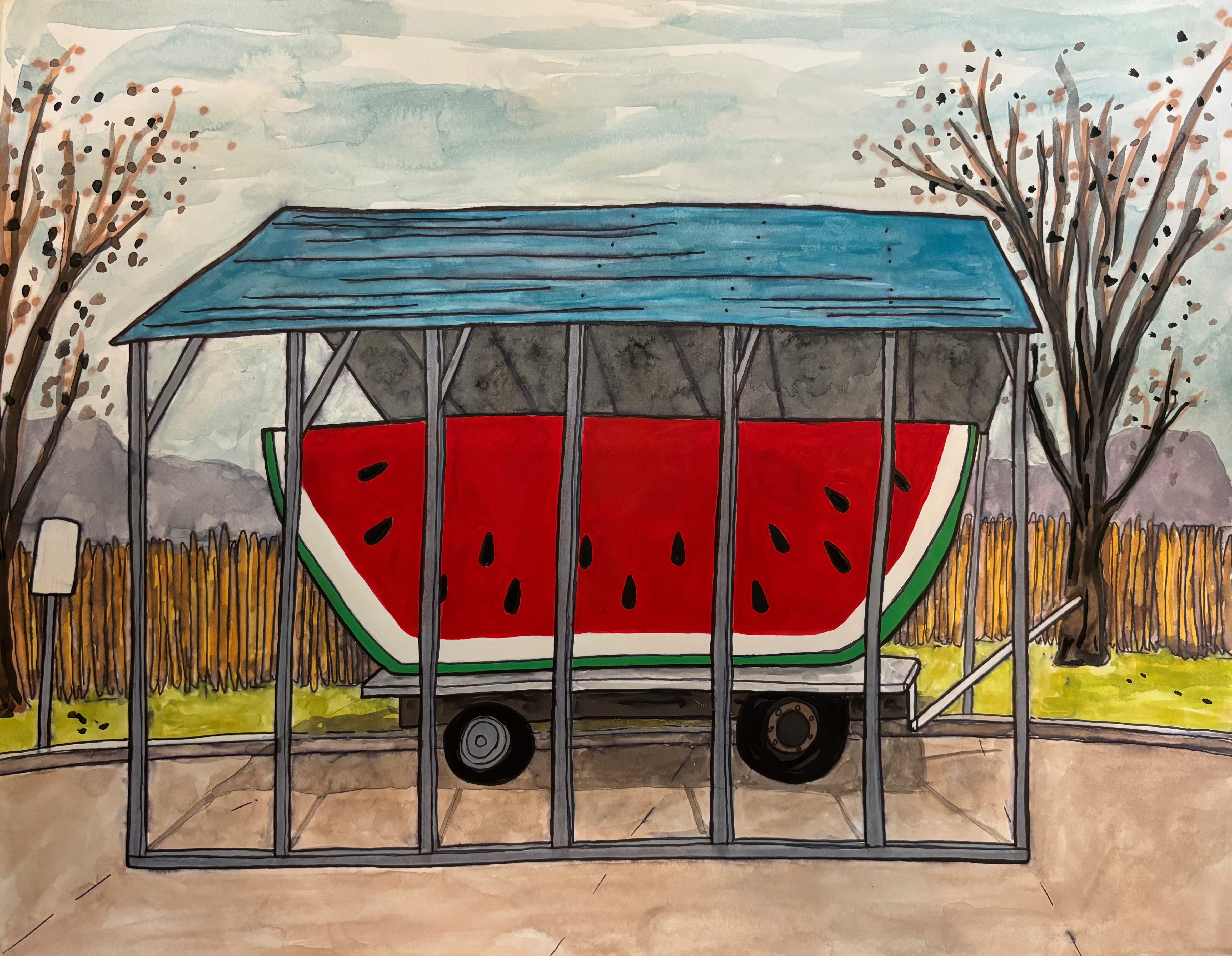
Enter into the scene a renowned Palestinian artist named Sliman Mansour who, in the early 1980s, made paintings of Palestinian life — people working in fields, olive groves, and also the struggle of his people. Apparently, an Israeli official came to his gallery to confiscate his artworks, commanding that he seek permission to make an exhibition and never make work using the colors of the Palestinian flag. Another artist who was in the gallery that day asked what would happen if he drew a flower with those colors, to which the official answered, “Even if you paint a watermelon, we will confiscate it." The new rules sparked a resistance and artists all over the world began painting watermelons as a symbol, still used today, of Palestinian identity, liberation, and solidarity.4
During my research, I read about another Palestinian artist named Vivien Sansour, whose work spans from film to culinary history to agriculture. She’s the founder of the Palestine Heirloom Seed Library and in 2016, she found a few remaining Jadu’l seeds and planted them. On her website, Sansour writes, “these seeds carry the DNA of our survival against a violent background that is seen across the hills and valleys through settlement and chemical input expansions.” She sees these seeds as subversive rebels.5
I can only imagine what it meant for Sansour and her community to reclaim this lost fruit. They must have watched the seeds grow and eventually flower, cheering those berries into full-fledged melons. They must’ve savored that first bite, tears and juice mixing together in a beautiful mess. They must’ve spit those seeds with intention, maybe into a field but likely into a cup to carefully save til next season. But was there a next season? Will there be one yet to come? The article I read about Sansour’s watermelon revival is nearly eight years old. The article has not been updated with news of the war, nor has her website. I do not know if the seed library still exists or if, like so many things, it has been destroyed. Alas, there is so little of Palestine that survives.
Now it is early summer and I recently had my first piece of watermelon for the season. It was a handheld rind-encrusted slice offered to me on a very hot day at the pool from a tupperware brimming with other slices. I slurped its juicy flesh and couldn’t help but think of Sansour. I can’t really eat melons without thinking about Gaza and the genocide that Israel is systemically inflicting upon the Palestinian people. They don’t have melons. Heck, they don’t even have flour. They are starving to death while I slurp watermelons in the sun.
According to the UN, over 400 people have been killed while trying to access humanitarian aid in the last several weeks. That’s on top of 55,000+ Palestinians who have been violently killed in a war that they are not equipped nor have chosen to fight. Once again, Israel is using food to manipulate, control and ultimately exterminate an entire people.6 This is illegal, immoral, and must be stopped.
Here’s the good news and the bad news: this unthinkable horror is being empowered by US taxpayers. In fact, we gave Israel more money last year than 89% of countries spent on their nation’s militaries (and that’s just a portion of our defense budget). An October 2024 study on “The Cost of War” found that the US military spent $22.8 billion to fund and protect Israel in just one year, including $17.9 billion sent directly to Israel.7 This is too much. We can stop this. We must!8
As watermelon season unfolds in all its juicy glory, please succor its colors and scents, its refreshing taste. Such earthly delights are meant to be enjoyed. But please, each time you eat watermelon, let yourself be seeded with rebellion. Remember Palestine. And let yourself flower towards a greater and kinder humanity.
Perhaps you’ve noticed watermelons all over the internet, a visual code for the movement to free Palestine.
Disclaimer: my history is not an expert one, nor is it complete. It may also reflect my bias.
I learned about Mansour from this NPR article.
Learn more about Sansour’s seed library here. She’s done a lot of amazing things all over the world!
You can read more about it here on Amnesty International’s website or this report from the United Nations.
This site has a lot of up-to-date numbers about how are tax dollars are spent. They also reference this report from Brown University about the costs of war.
Please call or write to your representatives and ask them to stop funding the genocide. Here’s a petition you can sign to stop US aid to Israel. Here’s another. And another.
oh erin, so beautifully written and helpful. what a mess we are in. i'm inspired to paint with a watermelon palette.